Peptide Lab Test Outcomes

 Reuben
2026-10-04 19:14
8
0
본문
All peptides sold by Pinnacle Lab are desired exclusively for in-vitro lab research study use and are not for human usage. Peptide screening paperwork ought to be interpreted as batch-level analytical evidence for research study product, not as clinical-use consent. Apex's How to Read a Peptide COA guide goes through this procedure detailed. The friend web page on why 99 percent pureness issues discusses why little impurity portions can still matter in delicate in-vitro assays.
This is why peptides are frequently provided at different pureness qualities. Very closely associated with truncations, deletion peptides are full-length chains that are missing out on one amino acid somewhere between. If capping isn't perfectly reliable, an uncoupled chain can continue to extend in succeeding steps, generating a peptide that's only one residue short of the target. These can be particularly problematic because their chromatographic behavior is very comparable to the target peptide, making them more difficult to divide during filtration.
When reviewing peptide quality, the majority of people focus on purity (HPLC) and identification (mass spec). Those confirm you have the correct particle and that it's relatively tidy from peptide-related byproducts. High-Performance Fluid Chromatography (HPLC) is the common technique for evaluating peptide purity.
Palmetto Peptides offers third-party COA documents for its research study peptide brochure, with testing executed by recognized outside analytical laboratories. See our post on recognizing COAs for research study peptides for examples using genuine COA frameworks. A COA that does not include endotoxin screening results is incomplete for any research study application entailing biological systems.
While several firms are experts in peptide synthesis, Cernum supplies an elite level of paperwork that lines up with the needs of both independent biohackers and institutional researchers. It takes understanding of formulation and threats incorporated with establishing specific analytical approaches for each basic material, basic material contamination, and so on to regulate the end product top quality. Scientists after that determine just how much of the overall signal belongs to the primary height. If 98% of the signal comes from the right peptide, the item is labeled "98% pure by HPLC." This is a conventional way of sharing peptide high quality throughout research study and pharmaceutical sectors. The research study worth of any kind of peptide substance depends directly on what is really in the vial. A substance stated to be 95% pure contains 5% of something else-- and in a study setting, that "another thing" issues.
In addition to HPLC and MS, specialized laboratories may employ orthogonal methods for included precision. For instance, capillary electrophoresis can be utilized to separate very hydrophilic peptides or to ascertain results, and MALDI-TOF mass spectrometry can assist in mapping bigger or customized peptides. Many peptide producers or Multi-Peptide Formula vendors will provide a COA (Certificate of Evaluation), for example our bpc 157 tb 500 blend, that consists of the pureness percentage by HPLC and identification confirmation by MS for each batch.
Qing Li Peptide guarantees this via rigorous production and QC. Straight from the synthesizer with very little handling-- usually simply cleavage from the resin and precipitation. Purity varies widely, from 40% to 80%+ depending upon series size and trouble.
We integrate LC-MS/MS and chemical food digestion analysis to precisely validate the sequence and alteration sites of non-natural modified peptides. Peptides, Multi-Peptide Formula with long molecular sequences and varied conformations, present challenges for framework verification and material determination. BOC Sciences leverages high-resolution mass spectrometry, LC-MS/MS, and NMR to properly analyze molecular structures and give very sensitive measurable support.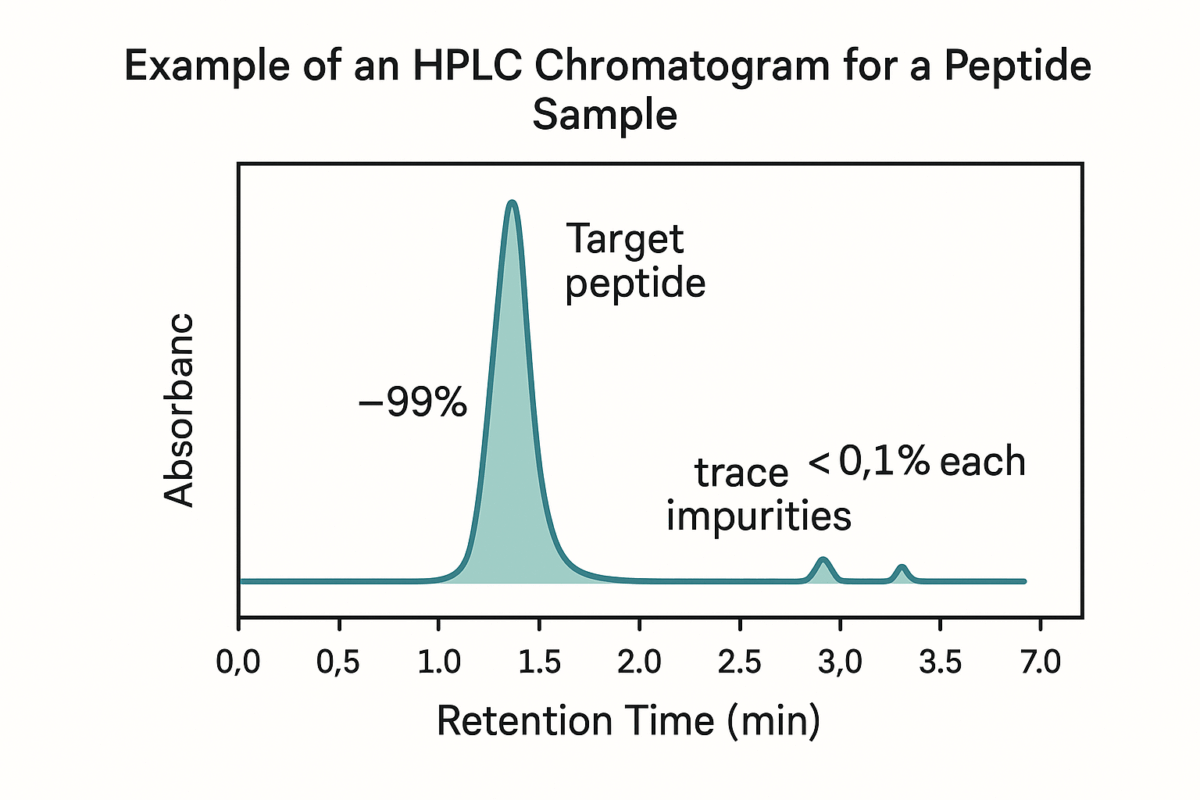
The friend web page on why 99 percent pureness issues discusses why little impurity portions can still matter in delicate in-vitro assays.This is why peptides are frequently provided at different pureness qualities. Very closely associated with truncations, deletion peptides are full-length chains that are missing out on one amino acid somewhere between. If capping isn't perfectly reliable, an uncoupled chain can continue to extend in succeeding steps, generating a peptide that's only one residue short of the target. These can be particularly problematic because their chromatographic behavior is very comparable to the target peptide, making them more difficult to divide during filtration.
Is 95% purity good for peptides?
Peptides with an 85% pureness degree or greater are generally utilized in enzyme assays or organic activity studies. Peptides with purity greater than 95% are outstanding for measurable analysis.
Just How To Submit Examples For Testing
When reviewing peptide quality, the majority of people focus on purity (HPLC) and identification (mass spec). Those confirm you have the correct particle and that it's relatively tidy from peptide-related byproducts. High-Performance Fluid Chromatography (HPLC) is the common technique for evaluating peptide purity.
- This connects straight with handling subjects such as peptide storage and peptide reconstitution.
- Organizations acquiring wholesale research study peptides often examine purity paperwork prior to placing larger orders.
- Peptide pureness describes the amount of the correct peptide in the peptide product.
- This figure represents just how much of the example is composed of the preferred peptide sequence.
- Particularly changed peptides or cyclic peptide sequences are difficult to verify, which influences quality control.
Palmetto Peptides offers third-party COA documents for its research study peptide brochure, with testing executed by recognized outside analytical laboratories. See our post on recognizing COAs for research study peptides for examples using genuine COA frameworks. A COA that does not include endotoxin screening results is incomplete for any research study application entailing biological systems.
While several firms are experts in peptide synthesis, Cernum supplies an elite level of paperwork that lines up with the needs of both independent biohackers and institutional researchers. It takes understanding of formulation and threats incorporated with establishing specific analytical approaches for each basic material, basic material contamination, and so on to regulate the end product top quality. Scientists after that determine just how much of the overall signal belongs to the primary height. If 98% of the signal comes from the right peptide, the item is labeled "98% pure by HPLC." This is a conventional way of sharing peptide high quality throughout research study and pharmaceutical sectors. The research study worth of any kind of peptide substance depends directly on what is really in the vial. A substance stated to be 95% pure contains 5% of something else-- and in a study setting, that "another thing" issues.
Encountering Peptide Evaluation Obstacles? Boc Scientific Researches Can Help!
In addition to HPLC and MS, specialized laboratories may employ orthogonal methods for included precision. For instance, capillary electrophoresis can be utilized to separate very hydrophilic peptides or to ascertain results, and MALDI-TOF mass spectrometry can assist in mapping bigger or customized peptides. Many peptide producers or Multi-Peptide Formula vendors will provide a COA (Certificate of Evaluation), for example our bpc 157 tb 500 blend, that consists of the pureness percentage by HPLC and identification confirmation by MS for each batch.
Qing Li Peptide guarantees this via rigorous production and QC. Straight from the synthesizer with very little handling-- usually simply cleavage from the resin and precipitation. Purity varies widely, from 40% to 80%+ depending upon series size and trouble.
Optimization Of Medicine Carriers And Delivery Systems
We integrate LC-MS/MS and chemical food digestion analysis to precisely validate the sequence and alteration sites of non-natural modified peptides. Peptides, Multi-Peptide Formula with long molecular sequences and varied conformations, present challenges for framework verification and material determination. BOC Sciences leverages high-resolution mass spectrometry, LC-MS/MS, and NMR to properly analyze molecular structures and give very sensitive measurable support.
댓글목록0
댓글 포인트 안내